Binary Lifting
Binary lifting preprocesses a rooted tree so that ancestor queries can be answered in time.
The canonical query asks for the -th ancestor of node : the node that is edges above it. The same precomputation is commonly used to find the lowest common ancestor (LCA) of two nodes.
Idea
The following diagram illustrates the parent relationships and longer jumps that binary lifting stores:
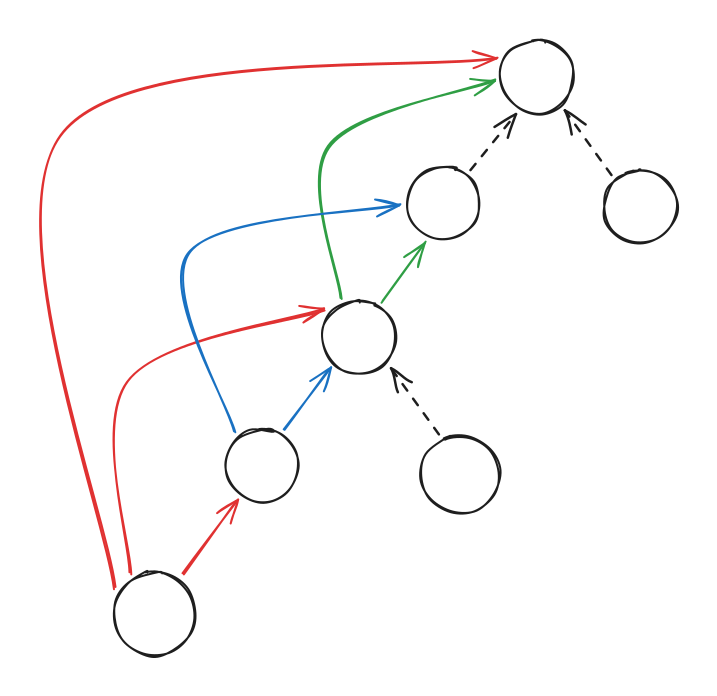
Each stored jump moves upward along the same path as the parent links, but skips a power-of-two number of edges.
Instead of storing only each node’s parent, store ancestors at power-of-two distances:
Any non-negative integer is a sum of powers of two. Therefore, to move steps upward, decompose into its set bits and take the corresponding jumps.
For example, . To find the 13th ancestor, make jumps of 8, 4, and 1 edges.
Building the Jump Table
Let be the -th ancestor of node . If the tree has nodes, the largest useful jump is less than , so use:
The first column is given by the tree’s parent relation:
Every later column follows from two half-sized jumps:
This recurrence says that a -edge jump is two consecutive -edge jumps.
Use a sentinel such as -1 for a nonexistent ancestor. The root’s parent is then -1, and the recurrence must not index through -1.
The following implementation builds the table from a parent array in which -1 marks a node without a parent:
# Assuming parent[u] = -1 if u has no parent
def build_jump_table(parent: list[int]) -> list[list[int]]:
    n = len(parent)
    log = max(1, n.bit_length())
    up = [[-1] * log for _ in range(n)]

    for u in range(n):
        up[u][0] = parent[u]

    for j in range(1, log):
        for u in range(n):
            mid = up[u][j - 1]
            if mid != -1:
                up[u][j] = up[mid][j - 1]

    return up
The guard prevents the implementation from indexing through the sentinel.
The parent array can be supplied directly, or computed with a depth-first or breadth-first search from a chosen root.
Finding the -th Ancestor
For each set bit of , jump from the current node to up[u][j].
def kth_ancestor(u: int, k: int, up: list[list[int]]) -> int:
    log = len(up[0])
    if k >= 1 << log:
        return -1

    for j in range(log):
        if (k >> j) & 1:
            u = up[u][j]
            if u == -1:
                return -1

    return u
For , this takes the jumps at bit positions , , and : 1, 4, and 8 edges. Their order does not affect the result because every jump follows the same path towards the root.
A query with
k = 0returnsuitself. Ifkis greater thandepth[u], the requested ancestor does not exist.
Lowest Common Ancestor
The lowest common ancestor of nodes and is their deepest shared ancestor.
- Lift the deeper node until both nodes have the same depth.
- If they now match, return that node as the LCA.
- Otherwise, try jumps from largest to smallest. Whenever the two nodes would land on different ancestors, take that jump for both.
- Return their parents as the LCA.
def lca(u: int, v: int, depth: list[int], up: list[list[int]]) -> int:
    if depth[u] < depth[v]:
        u, v = v, u

    u = kth_ancestor(u, depth[u] - depth[v], up)
    if u == v:
        return u

    for j in range(len(up[0]) - 1, -1, -1):
        if up[u][j] != -1 and up[u][j] != up[v][j]:
            u = up[u][j]
            v = up[v][j]

    return up[u][0]
Complexity
The following table summarizes the time and space costs of the preprocessing and query operations:
| Operation | Time | Space |
|---|---|---|
| Build the table | ||
| -th ancestor | ||
| LCA |
The table requires space; each query uses constant additional space beyond the table.
