Union Find Disjoint Set
The union-find data structure, also known as disjoint-set union (DSU), or union-find disjoint set, maintains a collection of disjoint sets.
It commonly supports two operations:
find(x): Return the representative/root of the set containingx.union(a, b): Merge the sets containingaandb.
A naive implementation stores each set as a rooted tree, where every node points to its parent and the root points to itself.
class UFDS:
    def __init__(self, n):
        self.parent = list(range(n))

    def find(self, x):
        while self.parent[x] != x:
            x = self.parent[x]
        return x

    def union(self, a, b):
        ra = self.find(a)
        rb = self.find(b)

        if ra != rb:
            self.parent[ra] = rb
This implementation has two problems: union can arbitrarily create tall trees, and find must repeatedly walk those trees to find the set representative.
Path Compression
Path compression optimizes find.
Whenever we call find(x), all nodes visited on the way to the root are directly attached to the root.
def find(self, x):
    if self.parent[x] != x:
        self.parent[x] = self.find(self.parent[x])
    return self.parent[x]
The following diagram shows a tree before and after path compression:
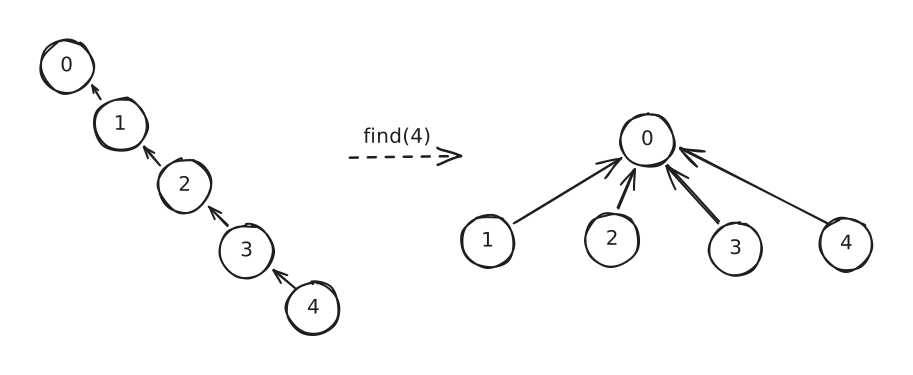
Path compression doesn’t avoid the cost of walking to the root the first time. It only makes future queries cheaper. It fixes bad trees after we access them, but it doesn’t prevent bad trees from forming in the first place.
Union by Rank
Union by rank optimizes union.
Instead of arbitrarily attaching one root under another, we try to keep the tree shallow.
The rank of a root is an upper bound on the height of its tree. When merging two sets:
- Attach the lower-rank root under the higher-rank root.
- If both ranks are equal, choose either root and increment its rank.
class UFDS:
    def __init__(self, n):
        self.parent = list(range(n))
        self.rank = [0] * n

    def find(self, x):
        ...

    def union(self, a, b):
        ra = self.find(a)
        rb = self.find(b)

        if ra == rb:
            return

        if self.rank[ra] > self.rank[rb]:
            self.parent[rb] = ra
        else:
            self.parent[ra] = rb
            if self.rank[ra] == self.rank[rb]:
                self.rank[rb] += 1
The rank isn’t necessarily the true height after path compression. Once path compression rewires nodes directly to the root, the actual tree height may decrease, but the rank is usually left unchanged. It remains a useful approximation for future unions.
Path Compression vs Union by Rank
Why Path Compression Alone May Be Enough Sometimes
At first, it may seem that union by rank should always matter. However, path compression alone can be sufficient in some problems.
Consider a problem where we first process all edges, then finally call find on every vertex once:
for u, v in edges:
    ufds.union(u, v)

for u in range(n):
    root = ufds.find(u)
Even if the union operations create a terrible chain, the final loop touches every vertex anyway. The first expensive find(0) walks the entire chain and compresses it. After that, most later calls are cheap.
The total work is still roughly linear in the number of vertices.
In this access pattern, the expensive traversal isn’t as wasteful because we were going to touch every vertex anyway. That’s why in some solutions, not implementing union by rank could lead to similar runtime performance.
An example of such a problem: Count the Number of Complete Components.
When Union by Rank Matters
Now consider a different access pattern.
Suppose the union operations create a long chain:
0 <- 1 <- 2 <- 3 <- ... <- 999999Then the only query we care about is find(999999).
Without union by rank, this single query must traverse the entire chain.
If we were never going to touch the intermediate vertices otherwise, then traversing them is pure overhead.
With union by rank, the tree would never become such a tall chain in the first place. The representative can be reached much more quickly.
So the distinction is:
- Path compression reduces the cost of future accesses.
- Union by rank reduces the cost of the first access by preventing tall trees from forming.
Performance Comparison
Let be the number of elements and be the number of operations.
| Optimization | Intuition | Worst-case behavior |
|---|---|---|
| None | Trees may become long chains. | find can be . |
| Path compression only | Bad trees are flattened after being accessed. | Individual find can still be expensive before compression. |
| Union by rank only | Bad trees are prevented from forming. | find is . |
| Union by rank + path compression | Trees are kept shallow and flattened over time. | Amortized per operation. |
is the inverse Ackermann function. For all practical input sizes, it’s effectively a very small constant.
Union by Rank Variants
There are a few common variants of the same idea.
Union by Rank
Union by rank stores an approximate height for each root.
if rank[ra] > rank[rb]:
    parent[rb] = ra
else:
    parent[ra] = rb
    if rank[ra] == rank[rb]:
        rank[ra] += 1
The rank only increases when two trees of equal rank are merged.
Union by Size
Union by size stores the number of nodes in each component.
if size[ra] < size[rb]:
    ra, rb = rb, ra

parent[rb] = ra
size[ra] += size[rb]
When merging two sets, attach the smaller component under the larger component.
For problems that already need to store the set/component size, it’s more convenient to implement union by size instead.
Arbitrary Union
Arbitrary union simply attaches one root under another.
parent[ra] = rbThis is the simplest version, but it gives the weakest guarantees.
With path compression, it may still be fine for many offline problems where all vertices are eventually touched. However, it’s less safe for general-purpose UFDS usage.
